NOK 273,098 a year
The full-rate introduction benefit, paid monthly while you learn the language and train for work. See Money.
Real support. Real numbers. Real welcome.
أهلاً وسهلاً خوش آمدید
Free healthcare. Free schooling. Child benefit. A two-year programme that pays you a monthly income while you get settled. This is what Norway actually offers newcomers — and it's bigger than most people expect.
*Case by case, not exclusive to any one group — see Notes.
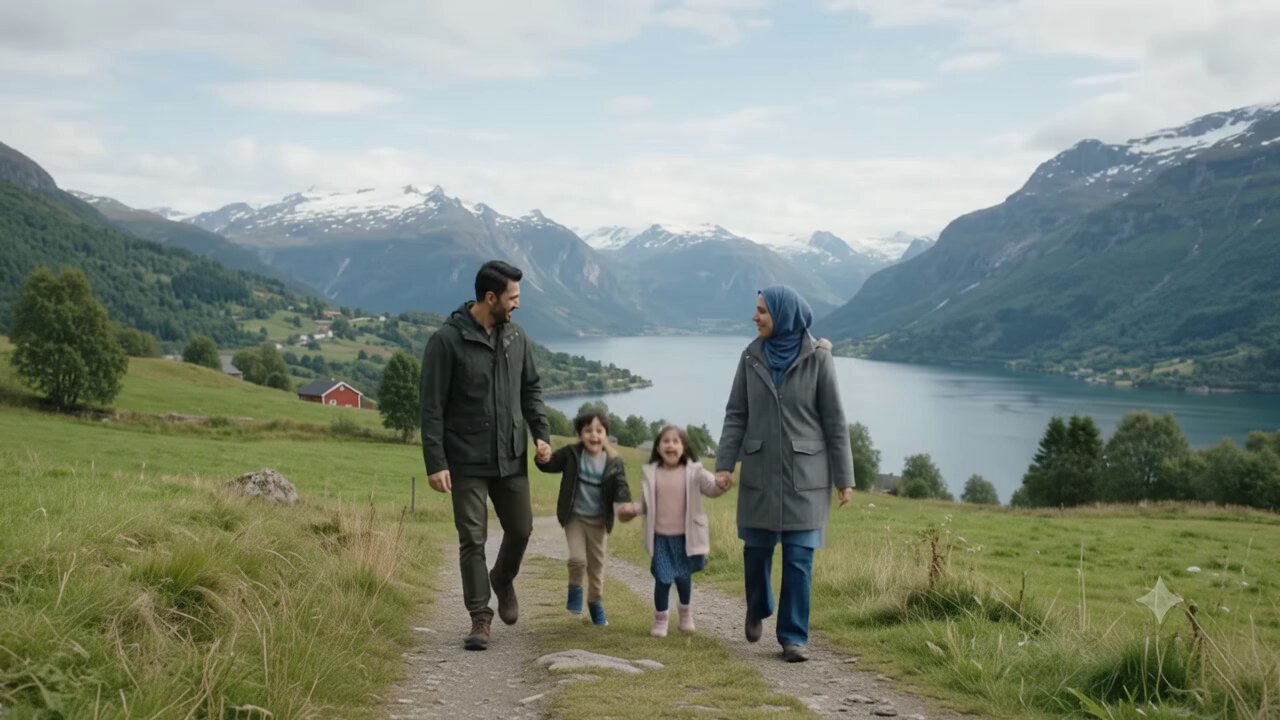
01 Start here ابدأ من هنا
Here's the headline version. Every number below is real, sourced, and further down this page in full detail.
The full-rate introduction benefit, paid monthly while you learn the language and train for work. See Money.
Public healthcare and schooling for every child, from day one of legal residence. See Health and Education.
Mosques, halal shops, and a Muslim community with fifty years of history in Norway. See Community.

02 Why Norway لماذا النرويج
A society that is unusually safe, with a labour market full of real openings and a landscape that's free to use. A way of living where children and family time are protected, not squeezed. Here's what's waiting for you.
Norwegians extend trust that surprises newcomers: doors left unlocked, children walking to school alone, lost wallets returned intact. It rests on low violent crime, a rarely armed police, and institutions that treat everyone the same — newcomers included, with binding contracts and decisions that can be appealed.
As a Folketrygden member, healthcare carries only modest co-payments — reach the low annual ceiling and Helfo issues an exemption card, free for the rest of the year Helfo. Children under 16 pay nothing at all for GP visits, psychologist appointments, outpatient care, X-rays, physiotherapy and reimbursement-list medicines Helfo.
Schooling from roughly six to sixteen is free, including books, once a child is likely to stay more than three months — even during the asylum process . (Adult dental care is the exception — see Healthcare.) None of this depends on having a job; see Money for what's paid regardless of work.
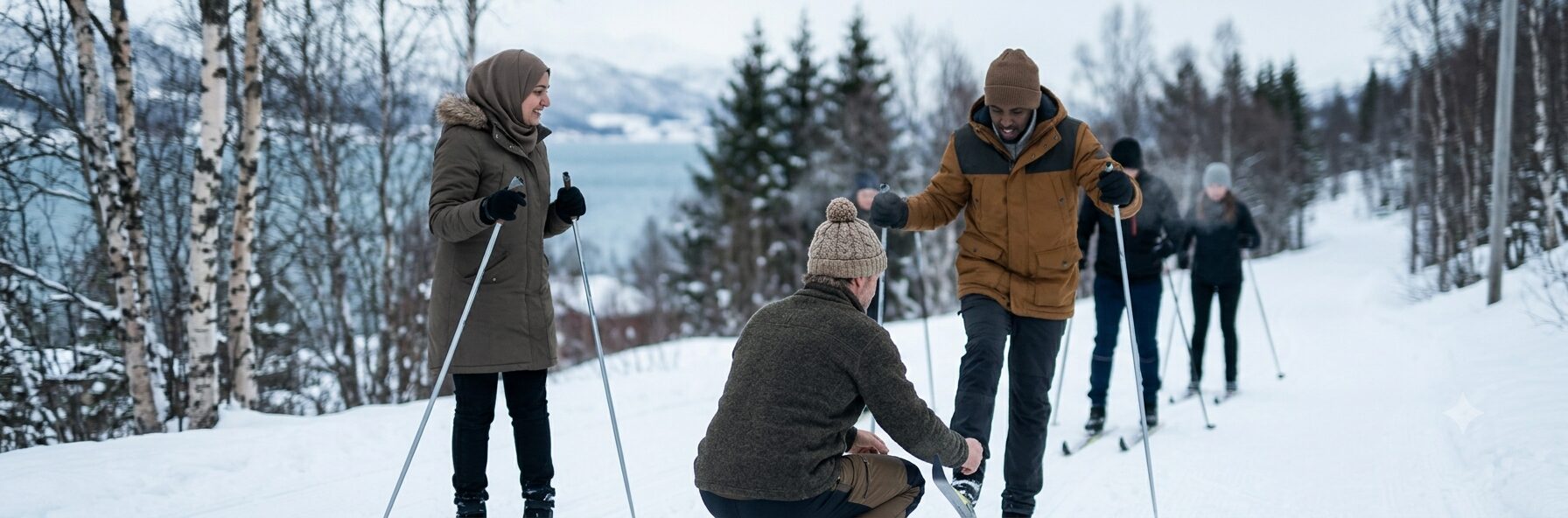
Norwegian law gives everyone the right to access most uncultivated land, coast and forest — walk, ski, pick berries, pitch a tent for a night almost anywhere without asking. Fjords, mountains and forest aren't reserved for those who can afford a membership; for most Norwegians they're a bus ride away.
Unemployment has stayed low — 1.9% on NAV's count as of May 2026, 2.1% seasonally adjusted . Employers reported roughly 39,000 unfilled positions in NAV's 2025 survey, concentrated in skilled trades (about 16,850) and health and care work (11,450 more) , with 21% of firms struggling to recruit . See Work for how foreign qualifications are recognised.
Leaving on time is normal here, not a sign of low commitment. Long paid parental leave is standard — part reserved for fathers — and taking it doesn't cost your career.
03 Money المال
Norway backs newcomers with real money at several points — a monthly income during the introduction programme, child benefit, support around birth and childcare, and thresholds that open the door to permanence and family reunification.
| Payment | Amount | Who it is for |
|---|---|---|
| Introduction benefit introduksjonsstønad |
NOK 273,098/yr full rate | Adults 18–60 taking part in the introduction programme — see The first two years |
| Child benefit barnetrygd |
NOK 2,012/mo per child | Parent or guardian of a child under 18 |
| Cash-for-care benefit kontantstøtte |
NOK 7,500/mo | Parents of a child aged 13–19 months, out of subsidised kindergarten |
| Birth grant engangsstønad |
NOK 92,648 per child | A parent who doesn't qualify for paid parental leave |
| Permanent residence — income requirement | NOK 310,070/yr | Anyone applying for permanent residence after 3 years |
| Family immigration — income requirement | NOK 436,957/yr | The Norway-based sponsor of a spouse, cohabitant or child abroad |
04 Health & dental الصحة والأسنان
Norwegian healthcare runs on national insurance membership, not your passport. Once you belong, most medicine is free or capped at a modest yearly amount — a GP, a hospital bed, a specialist referral, on the same terms as everyone else. Adult dental care works differently — the fact about Norway newcomers most often get wrong.
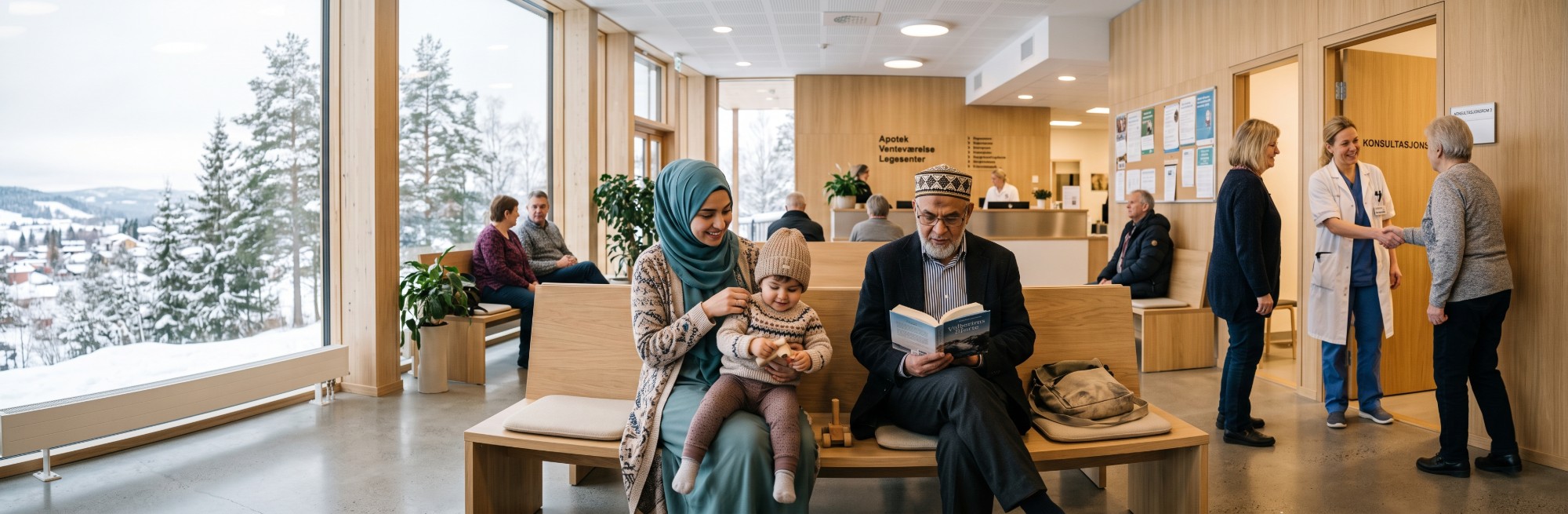
Folketrygden membership unlocks ordinary healthcare — a GP, a hospital bed, a specialist referral — on the same terms as a citizen. It's compulsory once you count as resident: staying, or intending to stay, at least 12 months ; where that intention exists from the start, membership backdates to entry.
From seeking protection until your case is decided, asylum seekers are covered by folketrygden's health provisions in their own right Helsedirektoratet, including full municipal health services, specialist referrals, necessary dental treatment, and a mandatory tuberculosis screening after arrival.
Most consultations carry a small co-payment, egenandel — GP, psychologist, outpatient clinic, physiotherapy, or pharmacy for blue-prescription medicine — capped: reach the yearly ceiling and Helfo issues a frikort, making every further visit that year free Helfo. Children under 16 pay no co-payment at all — GP, psychologist, outpatient appointment, X-ray, physiotherapy or blue-prescription medicine Helfo.
Public dental care is free for children and young people, from birth through the end of the year they turn 18 Lovdata, tannhelsetjenesteloven §1-3.
For young adults just past that age, the state still covers most of the bill: since 1 July 2025, everyone aged 19–28 pays no more than 25% of the fee Helfo, 2025.
05 Learning التعليم
Norway treats education as infrastructure, not a purchase: free schooling from day one, funded language and civic training, a second chance at upper-secondary study, and — for people granted protection — tuition-free university on the same terms as a citizen. Here's how each stage works, and what triggers it.

Grunnskole — primary and lower-secondary school, roughly ages 6 to 16 — is free, including books and materials. The duty to attend isn't tied to immigration status: once a child is likely to stay more than three months, schooling must start within a month Lovdata, opplæringsloven kap. 2 .
That applies to asylum-seeker children exactly as to everyone else — no final decision on the case is needed first.
Adults get funded Norwegian and civic training, samfunnskunnskap — 75 hours, capped at 225 for those without the full entitlement IMDi. Anyone 24+ who missed secondary school can complete it free (videregående opplæring) since 2024 Lovdata, 2024.
Since 2023, Norway charges non-EU/EEA students tuition — but refugees are exempt. Anyone with a protection-based permit or permanent residence studies free, on the same terms as a citizen Samordna Opptak. See Notes for the full detail.
Tuition-free isn't cost-free — books, housing and daily life still need funding. Foreign nationals with lawful residence based on protection, humanitarian grounds, or special ties to Norway can borrow and receive grants from Lånekassen, the state loan fund, on the same terms as citizens, including a specific flyktningstipend (refugee grant) Lånekassen. Material is published in Arabic, Somali, Tigrinya, Farsi and other languages.
Together, that's a rare combination: mandatory schooling regardless of your asylum case, a funded route into language and civic knowledge as an adult, a second chance at upper-secondary study after 24, and tuition-free university for refugees. It depends on knowing it exists, and asking for it.
06 Children & family الأطفال والعائلة
Norway pays a monthly benefit for almost every child, no matter who the parents are, from the first months of residence. Two other big payments, kontantstøtte and parental leave, are built on residence years or prior income instead.

Barnetrygd is a monthly, largely universal payment for every child under 18, regardless of parents' income. Single parents get a higher "extended" rate, plus a small supplement for a very young child on that rate.
| Payment | Amount | Who qualifies |
|---|---|---|
| Ordinary barnetrygd | NOK 2,012/month NAV, 2026 | Per child under 18, almost all families |
| Utvidet barnetrygd | NOK 2,572/month NAV, 2026 | Single parents, in place of the ordinary rate |
| Småbarnstillegg | NOK 712/month NAV, 2026 | Single parents with a child aged 0–3, on extended barnetrygd plus full transitional benefit |
| Finnmark / Svalbard supplement | NOK 512/month NAV, 2026 | Extra per child, for families resident in Finnmark or Svalbard |
Kontantstøtte pays NOK 7,500 a month to families not using a subsidised kindergarten place — but only for a child aged 13 to 19 months, a window narrowed from the previous 13–23 months in August 2024 NAV, 2024.
Parents who don't qualify for paid parental leave — usually for lack of recent work income — get a one-off payment instead, engangsstønad, currently NOK 92,648 NAV, 2024 per child.
Since 1 October 2024, it also requires 12 months' continuous folketrygden membership right before the birth or adoption date NAV, 2024.
Foreldrepenger pays 49 weeks at 100% of income, or 61 weeks at 80%. NAV's contribution is capped at roughly NOK 819,000 of annual income NAV, 2026. It requires work income before the birth; without Norwegian earnings yet, you'll typically fall back on engangsstønad instead.
07 Somewhere to live السكن
Norway doesn't leave you to sort out housing alone: a place to sleep while your claim is decided, ordinary rented housing once protection is granted, and real financial help — a housing allowance and a favourable loan — once settled. Where you live moves through these three stages in a fixed order as your status changes.
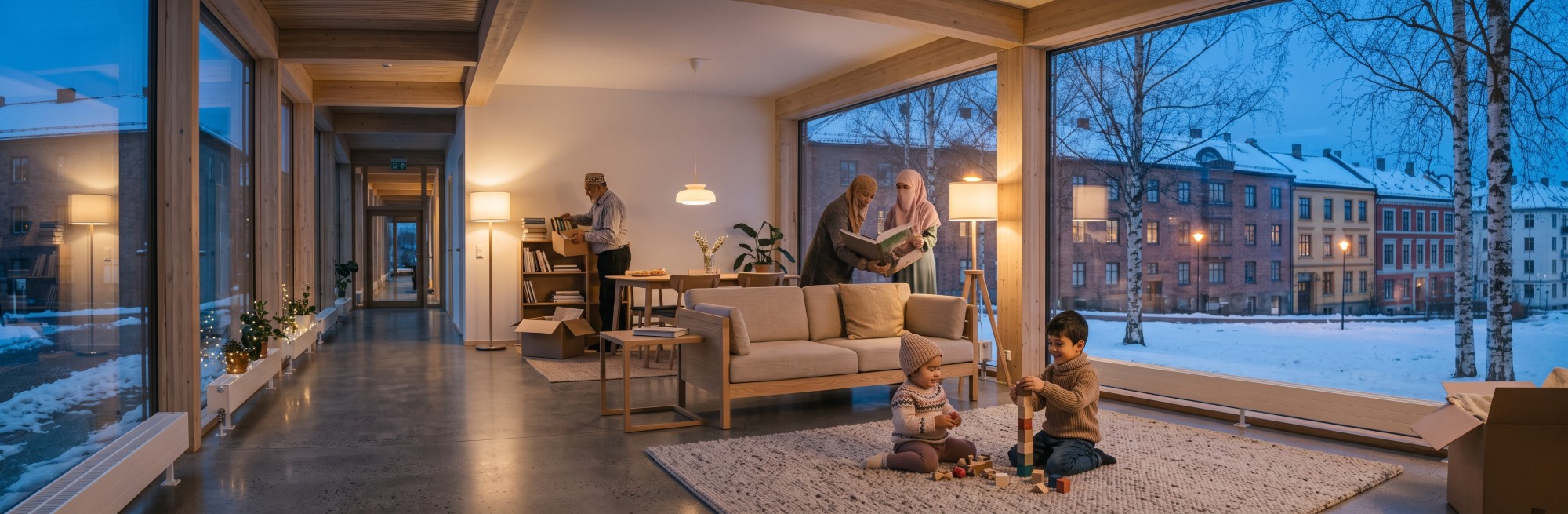
If you seek protection, UDI places you in a reception centre (mottak) while your claim is examined, providing a place to sleep, either food or means to cook, basic clothing and necessities, interpreters, and organised Norwegian-language activities while you wait.
Residents living in — or formally offered — a mottak place also keep the right to a small cash allowance, the basisbeløp. UDI sets the rate, which varies by case stage and centre type; it's paid twice a month, on the 1st and the 16th.
A grant of protection unlocks bosetting, organised settlement in a municipality: each year IMDi negotiates with municipalities over how many people each will take, and your settlement agreement comes before any tenancy — you don't choose the municipality freely.
Once settled, the municipality finds you ordinary rented housing in the local market, not a centre, and offers the introduction programme and Norwegian-language training described elsewhere in this guide IMDi. There's an alternative, bosetting på egen hånd: arranging your own housing instead of waiting for a municipal offer, without losing your right to protection.
Once in ordinary housing, two further supports exist, neither limited to refugees. Bostøtte is a means-tested housing allowance through Husbanken, weighed against household income, assets, housing costs, and household size. Startlån, also through Husbanken, is a loan for people who'd otherwise struggle to get an ordinary mortgage — explicitly available to refugees with valid lawful residence, assessed on the same criteria as anyone else. Apply through your local housing office.
08 Work العمل
Norway is short of tens of thousands of workers, concentrated in the trades and care work many newcomers already do. These are real openings, not scarce ones to compete for. What separates newcomers who find good work quickly: getting qualifications recognised early, and learning Norwegian fast.
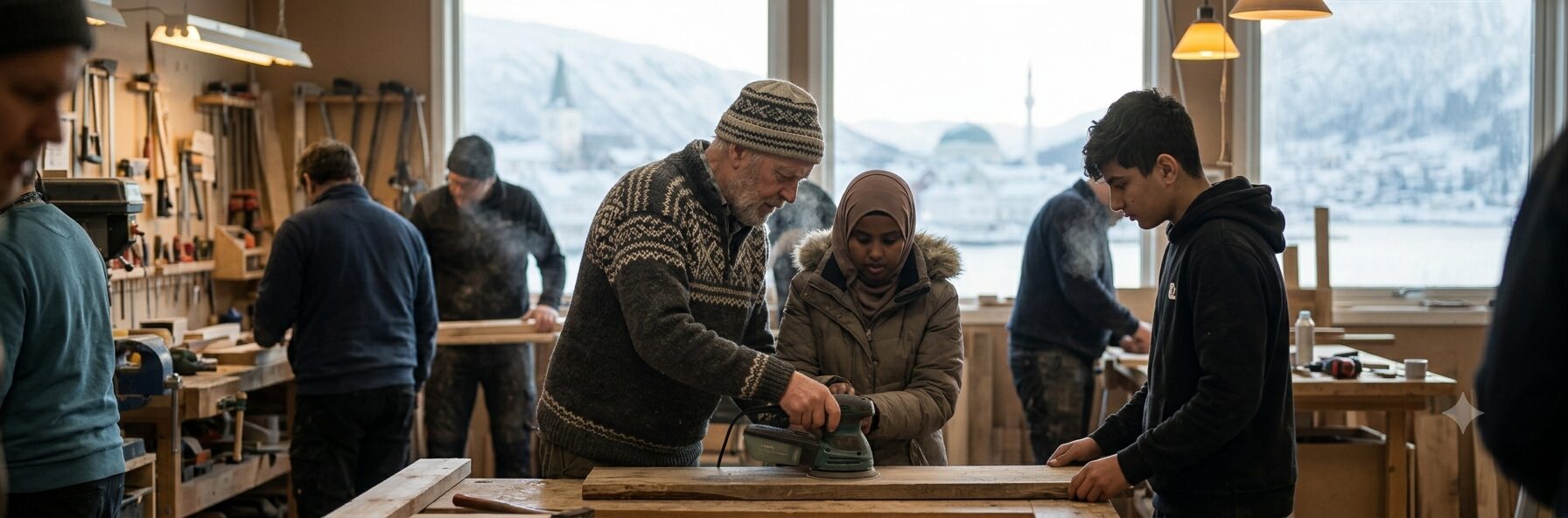
Norway measures unemployment two ways: SSB's labour force survey put it at 4.7% SSB, 2026, while NAV's jobseeker register showed 1.9% in May 2026, or 2.1% seasonally adjusted .
Low unemployment sits alongside a real worker shortage: NAV's 2025 Bedriftsundersøkelsen found businesses short roughly 39,000 workers — down from about double that at the 2022 peak . Twenty-one percent of firms reported recruitment difficulty .
| Area | Workers short |
|---|---|
| Total, all sectors | ~39,000 |
| Vocational / skilled trades (mechanical trades especially) | ~16,850 |
| Health and care work | ~11,450 |
| Firms reporting recruitment difficulty (last 3 months) | 21% |
Outcomes aren't equal: in 2023, 72% of immigrant men and 64% of immigrant women were employed SSB, 2023. Nordic and EU/EFTA immigrants match or exceed the national employment rate; those from Asia and Africa are markedly lower. The gender gap is largest in the first four years after arrival, narrowing over time SSB, 2023.
A trade certificate, nursing qualification or degree earned outside Norway needs formal assessment before use — gather original certificates, transcripts and translations early. For the skilled-worker route, UDI flags extra scrutiny for vocational trades: cook, car mechanic, carpenter, painter, bricklayer, hairdresser. Documents from a specific list of countries — including Pakistan, Bangladesh, China, India, Iran, Kosovo, Nepal, Turkey and Vietnam — face additional verification and longer processing .
09 The first two years برنامج الاندماج
Once someone has been granted protection and settled in a municipality, Norway offers a genuine running start: a full-time, structured, up-to-two-year programme — introduksjonsprogrammet — built around language, work and civic life, with a monthly income paid for taking part.
The introduction programme is not optional — under the Integration Act (integreringsloven, kap. 4), it is both a right and a duty for people granted protection, and family members, settled in a municipality by agreement Integreringsloven, Lovdata. The municipality must offer it full-time; it applies to ages 18 to 55, extended to 60 by a 2025 amendment Lov 2025-06-20-35, Lovdata. It runs up to two years as a main rule, extendable to three in some cases — confirm your own situation with IMDi IMDi.

The programme is full-time. The law sets out five elements, adjusted to the person IMDi:
Participation comes with a monthly income, calculated as a multiple of G, the National Insurance basic amount many Norwegian benefits are built on. From 1 May 2026, G is NOK 136,549 NAV, 2026.
The full rate is 2 × G a year — NOK 273,098 a year, or roughly NOK 22,750 a month, before tax NAV, 2026, reduced for younger participants without their own household, as below.
| Who | Rate | Approx. per year |
|---|---|---|
| Participant aged 25 or over | 2 × G (full rate) | NOK 273,098 |
| Under 25, not living with parent(s) | 2/3 of full rate | ≈ NOK 182,065 |
| Under 25, living with parent(s) | 1/3 of full rate | ≈ NOK 91,033 |
A 2024 law also reduced the rate for spouses or cohabitants without children in some circumstances — check the current figure with IMDi .
10 The community المجتمع کمیونٹی
Muslim life in Norway is a fifty-year story: from a handful of labour migrants in the late 1960s to a vibrant, multi-generational community today.
On 1 January 2026, for the first time, more than 200,000 people were registered members of a Muslim congregation — 201,899 people, across 288 congregations, up 2.3% on the year before and up 14.7% since 2022 .
Registered membership has nearly tripled in twenty years, from 72,000 in 2006 to today .
That figure counts registered members only, not everyone who considers themselves Muslim. SSB's last full population estimate, from 2016, put the total considerably higher .
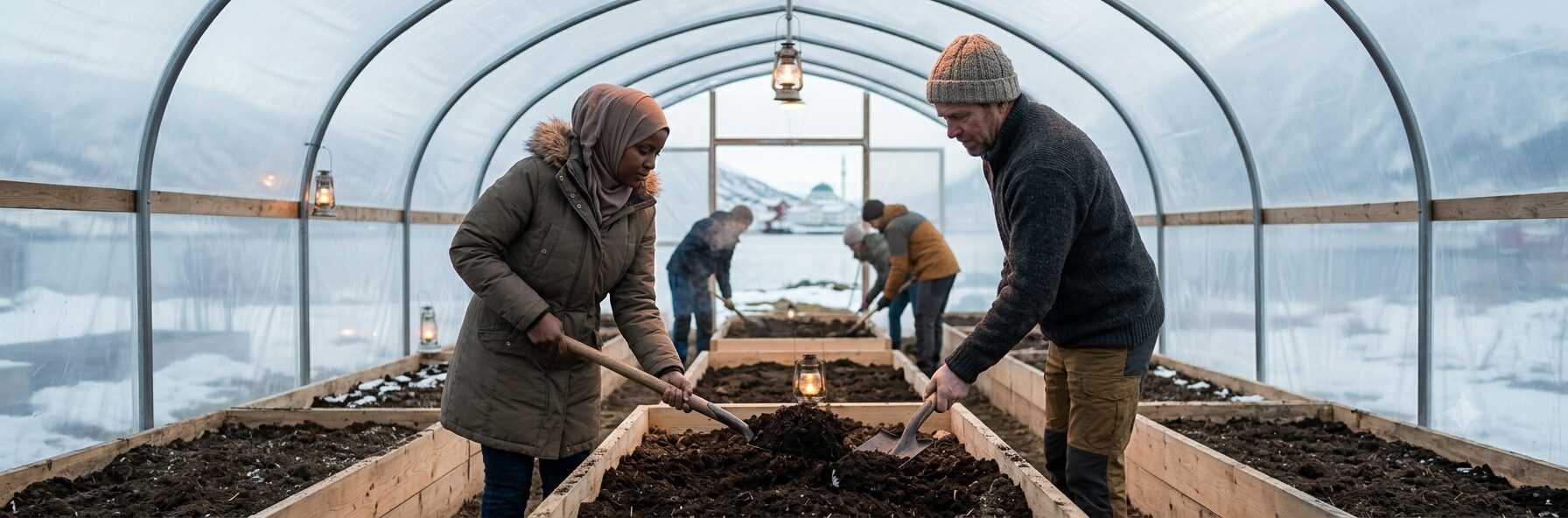
In 1967, a handful of Pakistani labour migrants arrived in Norway — around fourteen by the registration count — growing to roughly 110 by 1970 .
In 1971 the numbers jumped: 600–800 arrived in a single spring and summer, mostly single men, with NRK's own reporting putting the figure at around 800 by that August .
Those early years were hard: housing was overcrowded, and some men lived in parks and campsites before anything better could be arranged .
The largest single group with these roots is Pakistani-origin Norwegians: around 40,000 people in 2024, counting immigrants and Norwegian-born children of two Pakistani immigrant parents SSB, 2024.
Of that background, 45% were born here — the highest share of any large immigrant group SSB, 2024 — and 19,000 are Norwegian-born children of two Pakistani immigrant parents, the largest second-generation group of any origin country SSB, 2024.
About half of Oslo's roughly 23,000 Pakistanis live in Groruddalen SSB, 2024. Other communities: Somalis number around 27,600 immigrants plus 16,400 born in Norway to Somali immigrant parents SSB, while Syrians, at around 40,700, are mostly newer, having arrived largely after 2015 SSB. Bosnians, at around 19,049 in 2023, arrived as refugees between 1992 and 1995 SSB, 2023.
For Palestinian readers: after Norway formally recognised the State of Palestine in May 2024, a UDI instruction issued in October 2024 reclassified people holding Palestinian ID as citizens of a recognised state rather than stateless persons .
This changes which citizenship rules apply — the simplified path once used for stateless applicants no longer applies the same way.
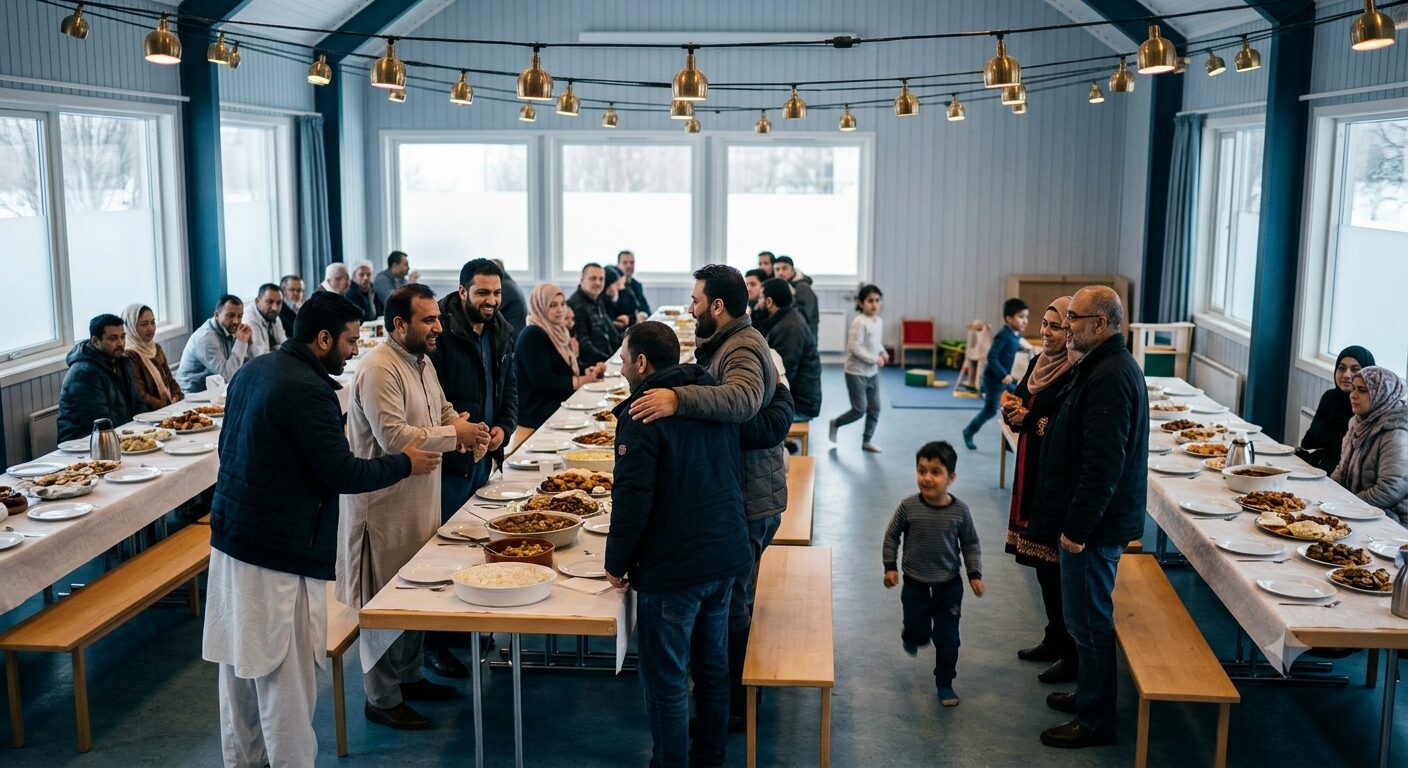
Muslim life in Norway is an established, multi-generational story that started with a handful of men looking for work in 1967.
11 Mosques المساجد
Wherever you settle, you'll find a place to pray. Norway counts 288 registered Islamic congregations, most small and woven into local life . A handful of Oslo mosques carry most of the community's documented history.
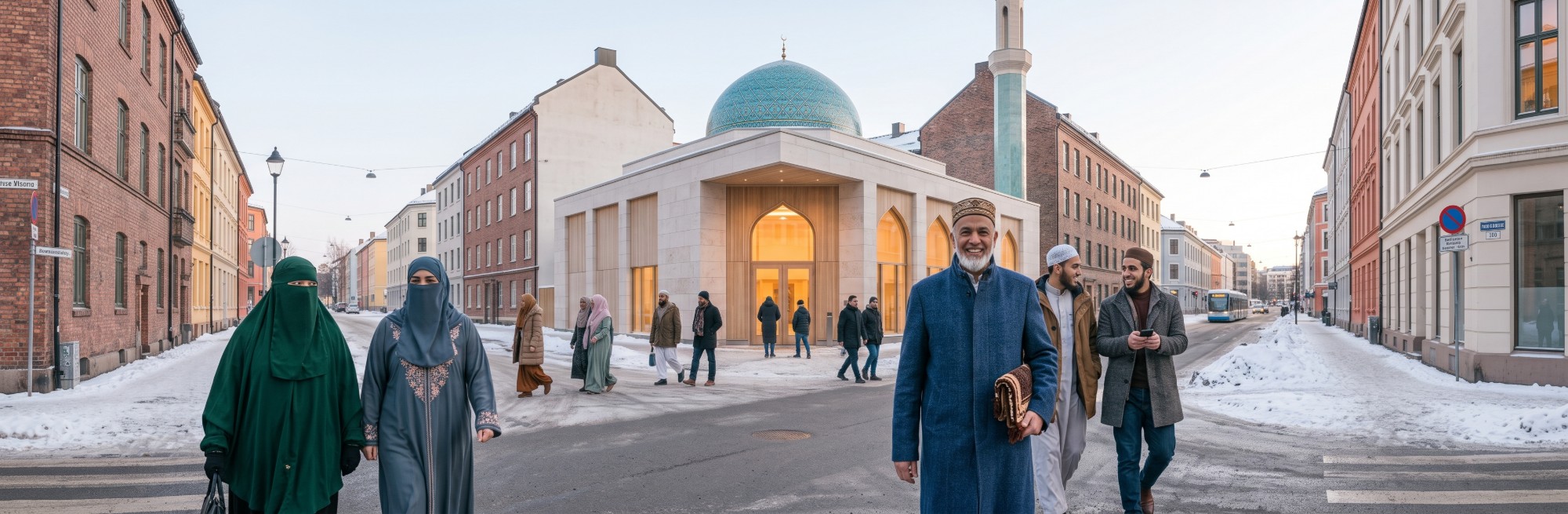
Founded in a private flat in Bjølsen by four Pakistani immigrants, the ICC is regarded as Norway's first Muslim congregation, marking its 50th anniversary in 2024 with around 3,500 members .
Founded as Anjuman-e Hanfia in 1977, renamed in 1979, the congregation met on Christian Krohgs gate before buying a warehouse at Urtegata 11 around 1989–90. Its purpose-built Jamea Masjid opened there in 2006 — 7,249 square metres, capacity 5,400, the largest mosque in northern Europe — with 6,094 registered members as of 2018 Wikipedia (no).
Known locally as Den blå moskeen, this was the first building in Norway constructed from the ground up as a mosque, designed by architect Eigil Wæhle. Its two hexagonal minarets and coral-blue facade, tiled with work from Iran and Spain, were later restored to their original colour .
Rabita was the first Oslo mosque not organised around a single national or ethnic group; it moved into its own premises in 2004. Its largest background group is Moroccan, with 3,318 members in 2018. King Harald V and Crown Prince Haakon visited on 19 October 2009 Wikipedia (no).
Minhaj-ul-Quran began with twenty to thirty people meeting in two rented rooms in Tøyen in 1990, and has since grown into the Minhaj Senteret on Enebakkveien Wikipedia (no).
Mosques now serve most of Norway's larger towns. Bergen Muslimske Forening has more than 500 members, and Trondheim's Mevlana Kultur Forening recorded 1,509 in 2018. Mevlana Moské in Stavanger and Drammen Tyrkiske Islamske Menighet (over 500 members) serve Turkish-background communities; Muslimsk Union i Agder serves Kristiansand .
Two national organisations coordinate between mosques. Islamsk Råd Norge (IRN) is the older, larger umbrella body: in early 2017 it represented around 82,000 Muslims through 42 member organisations, before a trust crisis saw several congregations leave and the government halt its public funding Wikipedia (no). It reports it has since reformed, now counting 80–85 member organisations covering more than 75,000 people Islamsk Råd Norge. It runs the Hijri calendar function fixing Ramadan's start and end, the IRN Halal certification mark, and the request forms for statutory Eid leave.
Muslimsk Dialognettverk (MDN) was founded in 2017 by five organisations that left IRN then: the Islamic Cultural Centre, Rabita, the Bosnian Islamic community, Center Rahma and the Albanian Islamic Cultural Centre. It represents around 30,000 members today .
Since 1 January 2021, a single law — trossamfunnsloven — has governed state and municipal funding of every registered faith and life-stance community on the same basis Trossamfunnsloven, Lovdata.
It's a per-member grant, calculated so funding per member roughly matches state spending per member of the Church of Norway. The rate was NOK 1,353 per member in 2022, NOK 1,554 in 2025, and NOK 1,611 in 2026 .
One asymmetry remains, written into the Constitution: Grunnloven §16, last amended in 2012, guarantees freedom of religion and states all faith and life-stance communities are to be supported on an equal footing. But it also names the Church of Norway specifically as the country's folkekirke, the people's church Grunnloven §16, Lovdata.
12 Everyday practice الحياة اليومية
Good news first: halal meat is easy to find, prayer spaces are built into everyday Norwegian life, and Eid is recognised and accommodated.
This section covers halal meat, burial, prayer, Eid, and what the law says about religious dress.
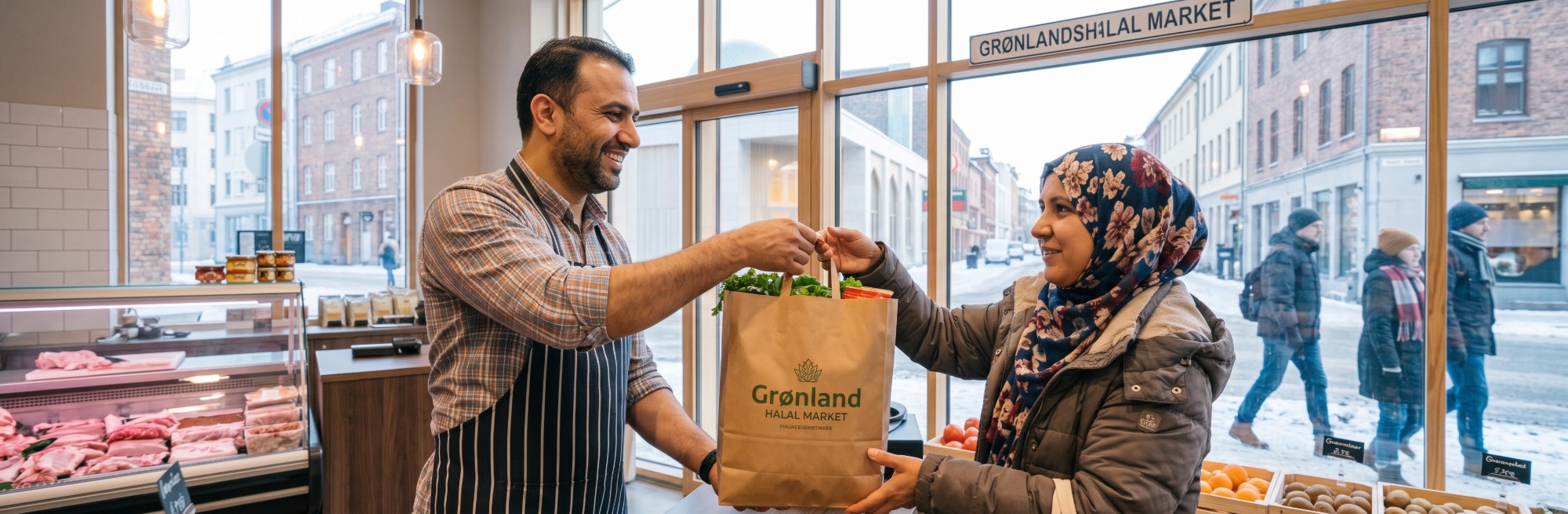
Halal retail is well established in Norway's larger cities, with hubs in Oslo's Grønland, Tøyen and Furuset. Nortura, Norway's largest meat cooperative, also sells its own halal-certified brand, Alfathi, in ordinary supermarkets nationwide, certified largely by IRN Halal.
Norwegian law gives every resident the right to burial according to their religious conviction — Gravplassloven §1 places a duty on municipalities to accommodate this as far as practicable, built into infrastructure, not just promised Gravplassloven, Lovdata.
Alfaset gravlund in Oslo's Alna district has direction-oriented graves plus a separate Ahmadiyya field; Klemetsrud offers similar provision. Dedicated services such as Muslimsk Begravelsesbyrå handle the practical and religious steps for families who need it.
The University of Oslo has had dedicated prayer rooms with wudu facilities since the 1990s; OsloMet provides gender-separated prayer rooms; the University of Bergen offers similar.
Oslo University Hospital runs a spiritual-care service covering ten faith and worldview communities, including a Muslim chaplaincy, and St. Olavs Hospital in Trondheim has employed a Muslim cultural consultant since 2010 .

Eid al-Fitr and Eid al-Adha are widely marked in Norway but are not an official public holiday. Arbeidsmiljøloven §12-15, the Working Environment Act, gives any employee who isn't a member of the Church of Norway a statutory right to up to two self-chosen days of leave per year for religious holidays, explicitly covering Eid al-Fitr and Eid al-Adha, with at least 14 days' notice to your employer Arbeidsmiljøloven §12-15, Lovdata. The leave is in principle unpaid, but most employers let staff work the hours back. The same right extends to school pupils as authorised absence, and IRN publishes request forms.
There is no fully sharia-compliant bank in Norway, though Storebrand Bank reportedly offers an interest-free home loan structured as a diminishing occupancy fee. Other banks say they're considering similar products but haven't launched one, despite a 2016 Civita report documenting unmet demand among Muslim customers.
The hijab is not banned in Norwegian schools, workplaces, or the military. Face-covering garments like the niqab and burqa have been banned in education settings since August 2018, from kindergarten through higher education, but only during actual teaching, with exceptions for pedagogical, health, weather or safety reasons .
The police do not currently permit the hijab with the uniform: the Police Directorate moved to allow it in 2008–09, but the Ministry of Justice reversed that in 2009, and a political debate continues, including a 2024 push from within the Labour party. The military, by contrast, has permitted the hijab, turban and kippah with uniform since 1 July 2012, worn tied close to the head under issued headgear .
13 Family & law الأسرة والقانون
Norway is one of the most family-supporting societies in the world — generous parental leave, subsidised childcare, free healthcare and free schooling, built into everyday life.
It's also a society with firm rules about how children are raised and how adults may be treated within a family.
Norwegian policy makes raising children materially easier. Parental leave is long and paid, with a portion reserved for the father, and kindergarten is subsidised and capped, with further reductions for lower-income families. Child benefit is paid monthly for every child, to almost everyone, regardless of income. Healthcare and school, including books, are free.
Raising your children in your faith is lawful and ordinary here. Families teach children to pray, fast, read Quran, and attend weekend mosque classes, and schools accommodate religious observance. Nobody is required to abandon their religion or culture as a condition of residence.
A small set of rules applies to every family in Norway without exception. None targets Muslims — they apply identically to Norwegian families.
Norwegian law guarantees equal treatment regardless of sex, religion, ethnicity, disability and sexual orientation. It's what makes it unlawful for an employer to refuse you a job for being Muslim or wearing hijab, and it's also what gives your daughter the same legal rights as your son, lets a same-sex couple marry, and lets a woman decide whom she marries and whether she works.
You don't have to agree with every social outcome, but you do have to live within the law.
14 Routes طرق الوصول راستے
Norway has several doors, not equally open — the route most people ask about first is the narrowest. Below: each route, what it requires, and how well it works.
Realistic · the main door
Norway's main immigration door. Requires a job offer from a named employer, in a role matching your qualifications — trade certificate, bachelor's or master's — with pay matching Norway's norm.
Degree-level jobs have salary floors: from 1 September 2025, NOK 599,200 a year before tax for master's-level posts, NOK 522,600 for bachelor's-level . Trade and vocational jobs follow the trade norm instead of a fixed figure.
Straightforward cases take one to four months, leading to permanent residence via the ordinary three-year route. A job-seeker permit of up to a year exists for workers without an offer yet, though that time doesn't count toward it .
Realistic · if you have someone here
If you have a spouse, parent or child in Norway, this route is real. The sponsor needs NOK 436,957 a year before tax, from 1 February 2025 . Spouses and cohabitants must be at least 24.
Exception: if the sponsor holds refugee status or collective protection, the requirement does not apply to their spouse, cohabitant or child (marriage must predate arrival, for spouses). See the next section for the one-year deadline that applies.
Open · but count the cost honestly
Show you can support yourself — NOK 15,488 a month, or NOK 170,368 for a full academic year — through loans, grants, own funds, or an institutional deposit. The permit allows work up to 20 hours a week in term, full-time in holidays.
From 2023, public universities had to charge non-EEA students full cost — NOK 130,000 to NOK 390,000 a year depending on subject — and non-EU enrolment fell about 80 per cent in two years. From 1 August 2026, that requirement was removed — institutions now set their own fee policy, so write and ask rather than assume a price.
No route to travel · claim only on arrival
Norway has no asylum visa and no humanitarian visa. You cannot lodge a protection claim at a Norwegian embassy. UDI states plainly: "Norwegian authorities are not able to help you to travel to Norway" .
A claim can only be made once you're physically in Norway or at its border. Since 15 July 2024, everyone must register in person at the National Arrival Centre at Råde.
Norway also takes part in Europe's responsibility-sharing system — Dublin, replaced by the Asylum and Migration Management Regulation from 12 June 2026 — so a claim generally transfers to the first participating country you entered, or the one that issued your visa. Because almost every route crosses such a country first, transfer back is routine, not exceptional.
The protection system is real and, for some, generous — but it has no mechanism for getting you there. Anyone who says otherwise — an agent, a broker, a relative — is mistaken or selling you something. Full process, recognition rates, and specifics for Gaza and Pakistan are in the next section.
The one lawful route from outside · and very narrow
The only lawful route to protection status in Norway from outside the country. It runs entirely through UNHCR: you can't apply to UDI, and can't choose Norway as your destination.
You approach a local UNHCR office, which decides if you qualify as a refugee and whether resettlement is your only solution, then may refer your case to Norway or elsewhere .
Norway's parliament sets the quota yearly: 3,000 at its peak in 2016, 2017 and 2019; 1,000 in 2024; around 500 in 2025, prioritising Syrians in Lebanon, Jordan and Turkey, and Afghan women — cut sharply again for 2026 . UNHCR has asked Norway to move toward 5,000 a year.
Cannot be applied for
Norway's Immigration Act allows group-based protection in a mass-flight situation, without individual assessment — activated by government, not requested. Used three times: Bosnians in the 1990s, Kosovo Albanians in 1999, Ukrainians from March 2022 .
Currently narrowed even for Ukrainians. Doesn't lead to permanent residence, and covers no other nationality.
15 Protection الحماية واللجوء
For people already in Norway, on their way, or weighing whether to try: how the process works, what outcomes have been, and one deadline that separates families every year.
Norway's recognition rate swings sharply year to year, driven almost entirely by who is applying. In 2024 the EU Agency for Asylum put it at roughly 73 per cent, shaped by Syrians, then granted protection at very high rates.
By September 2026, new UDI figures told a different story: of cases examined on their substance, around 22 per cent were granted protection or residence on another basis, and around 78 per cent were refused Utrop / UDI, 2026. What changed was Syria: after the Assad government fell in December 2024, UDI paused and reassessed Syrian cases.
In 2025 only 14 per cent of decided Syrian claims were granted — 16 of 112 — against 93 per cent for Eritreans, 74 of 80 Utrop / UDI, 2025. The biggest factor in any claim is the situation in the country you left, and that can change faster than a journey takes.
Recognition rates for Pakistani applicants are low across Europe: the EU Agency for Asylum recorded roughly 11 to 15 per cent granted at first instance across EU+ countries in 2024, around 12 per cent in 2025 EUAA, 2025.
Pakistan isn't treated as facing a general risk situation; claims are assessed individually, and most don't succeed. We aren't publishing a Norway-specific percentage — UDI publishes figures by citizenship and outcome; read them yourself . If your situation is genuinely individual — a specific, documented risk — get free legal advice rather than take anyone's discouragement as final.
If the plan is economic instead, the skilled worker route in Routes has a far higher success rate, leading to the same permanent residence.
Norway's treatment of this group is favourable, once present. Stateless Palestinians registered with UNRWA are assessed under Article 1D of the Refugee Convention and section 28 of the Immigration Act — most outside UNRWA's operational area receive protection.
On Gaza specifically: the Immigration Appeals Board suspended the duty to leave for people from Gaza on 18 October 2023, lifted on 24 September 2025. But UDI and UNE state nobody will actually be returned to Gaza — those refused still get individual postponed removal, given the security situation .
After Norway recognised the State of Palestine in May 2024, a ministry instruction of 17 October 2024 reclassified Palestinians holding Palestinian ID as citizens, not stateless persons — removing their simplified route.
A grant of protection unlocks nearly everything else on this site. You're settled in a municipality, responsible for housing and offering the introduction programme and Norwegian training. The two-year programme in The first two years begins, with an income attached, and the health, schooling and family provisions that follow apply to you.
16 What to prepare for ما يجب الاستعداد له
Every earlier section covered what Norway offers — this one covers what actually gets hard, so you can prepare rather than discover it alone.
Most newcomers brace for cold and are surprised by darkness instead. In the far north the sun doesn't rise for weeks; even in the south, winters are short and grey for months. Cold is manageable — buildings are heated, proper clothing handles the rest — darkness is what wears on people.
What helps: go outside daily, even briefly; keep homes and workplaces well lit; use the daylight that exists, especially at midday.
Norwegian, not English however good yours is, decides your first five years — workplaces, healthcare, school meetings and the introduction programme all run on it. It's learnable, and training is paid for through the programme, but nobody can do the learning for you.
Rented housing near the larger cities is in real demand, and finding something suitable takes effort in your first months in a new municipality. That's one reason bostøtte and startlån exist — check bostøtte even if you assume you won't qualify, since the ceiling depends on household size and region, not one fixed number.
New arrivals often read Norwegian reserve as coldness. It's closer to a different rhythm: small talk with strangers isn't the norm, and friendship forms slowly, usually through doing something together — a sports club, a workplace project, your children's school — rather than conversation alone.
In 2023, 72% of immigrant men and 64% of immigrant women were employed; those from Asia and Africa had lower employment rates than those from the Nordic countries or EU/EFTA, at or above the general population SSB, 2023.
The gender gap is widest in the first four years and narrows with time. See Work for what closes it fastest.
Norwegian hiring research found job applicants with distinctly Muslim names face the highest discrimination among minority groups studied. A separate report from HL-senteret and IMDi found Muslims are the primary target of hate crime and cultural racism in Norway: in one youth survey, 67 of 90 young Muslim respondents reported hate, discrimination or exclusion for being Muslim; around 25% of a broader survey reported harassment in the past twelve months IMDi/HL-senteret, 2023. The government ran a national action plan against discrimination of, and hatred against, Muslims from 2020 to 2023.
Discrimination on grounds including religion is unlawful under the Equality and Anti-Discrimination Act Lovdata, enforced by the Equality and Anti-Discrimination Ombud (LDO).
Being far from parents, siblings and old friends is part of this move. If you're granted protection and your spouse or children apply to join you, the usual income requirement is waived — but generally only if the family applies within one year of your protection grant.
What counts is the date your family member physically attends their biometrics appointment, not any online pre-registration. If reunification applies to you, act on it first.
17 Questions أسئلة شائعة
Real questions newcomers ask, answered straight — a wrong answer can cost someone their savings, years, or worse.
No. A claim requires being in Norway or at its border — "Norwegian authorities are not able to help you to travel to Norway" . There's no asylum visa or embassy route; the only option from outside is a UNHCR resettlement referral, which you can't apply for yourself .
No. Norway treats UNRWA-registered stateless Palestinians favourably and won't return anyone to Gaza — but that's not a route in: no asylum visa exists, borders are closed, and a claim still requires being in Norway or at its border.
Usually, yes. Norway follows the Dublin system, replaced by the similar EU-wide AMMR from June 2026 — responsibility falls on the first participating country you entered or that issued your visa, and UDI will usually transfer you there .
Low. Norway doesn't publish a Pakistan-specific figure, but EU-wide recognition for Pakistani applicants ran roughly one in eight to one in six in 2024 and 2025 EUAA. Pakistan isn't on Norway's safe-country list, so claims are case by case . Consider the work, study and family routes first.
Only partly. Free from birth through the year you turn 18 Tannhelsetjenesteloven, Lovdata. From 1 July 2025, adults 19–28 pay at most 25% of set fees Helfo — except those on a temporary permit with under five years' residence, per a 2024 law. Outside those ages, adults get no public dental cover.
Paid to people granted protection (or a covered family member) once settled in a municipality. Full rate: 2 × G a year — at the current G (NOK 136,549 from 1 May 2026), about NOK 273,000 a year, NOK 22,750 a month NAV. Taxable, no pension rights; under-25s get two-thirds alone, one-third with a parent .
Yes — refugee status or collective protection waives the income requirement for your spouse, cohabitant or child (a spouse's marriage must predate your arrival). Apply within one year of your protection grant to keep it .
No. Norway has permitted dual citizenship since 1 January 2020 — you don't need to renounce your previous nationality . Whether Pakistan or another country lets you keep it depends on that country's own law.
Permanent residence needs three years' continuous lawful residence, oral Norwegian at A2, a social-studies test, and income of at least NOK 310,070 before tax over 12 months (2025, exemptions for some refugees) . Citizenship needs 8 of the last 11 years on valid permits, 6 of 10 with sufficient income, or 3 of 10 (1 year) if married to a cohabiting Norwegian citizen, plus B1 spoken Norwegian ; a 2026 consultation may lengthen these.
It rises with your rights: A2 for permanent residence, B1 for citizenship . Course-hour documentation was dropped from 1 September 2025 — passing the test is what counts. Most reach this level in the introduction programme (see above), full-time, over up to two years.
At school and work: yes, without restriction — the face-covering ban targets niqab and burqa in teaching only, not hijab Lovdata. In the military: yes, since 1 July 2012. In the police: no, since a 2009 reversal that still stands, though contested.
Yes. Nortura, Norway's largest meat co-operative, sells a halal-certified brand (Alfathi) in ordinary supermarkets. Law has required stunning before slaughter since 1929, with no religious exemption, so "halal" here means stunning first, then Muslim-approved processing Mattilsynet.
Yes — employees outside the Church of Norway may take up to two self-chosen leave days a year for religious holidays, covering Eid al-Fitr and Eid al-Adha Arbeidsmiljøloven §12-15, Lovdata. Notify your employer 14 days ahead; leave is unpaid.
They're taught about it, alongside other religions, in KRLE — Christianity takes roughly half the teaching time by design Lovdata. Full exemption isn't available, but a partial one is: with written notice, a pupil can skip activities like a mosque visit or Christian prayer. Pupils 15+ may request it themselves.
No Islamic private school operates in Norway. Urtehagen ran 2001–2004 and closed after a critical inspection; a 2014 application was approved, then overturned on appeal. What exists, almost everywhere there's a mosque, is weekend schooling in Arabic, Quran and Islamic history alongside state school.
If you hold a permit based on protection, strong humanitarian grounds, special ties, or permanent residence: yes, tuition-free . Grunnskole (ages 6–16) is free for every child once likely to stay over three months Lovdata. Otherwise, since August 2026 institutions set their own fee policy — ask directly.
Show you can cover NOK 15,488 a month, or NOK 170,368 a year (2025 figures) . Protection or humanitarian permit holders get Lånekassen loans on citizen terms . You may work 20 hours a week in term, full-time in holidays.
Almost certainly, if the city has any size. Norway has 288 registered Islamic congregations as of 2026, with major mosques in Oslo and communities in Bergen, Trondheim, Stavanger, Drammen and Kristiansand SSB. See Mosques & institutions for addresses.
Barnevernet is the child welfare service, feared well beyond what its work justifies — mostly support: advice, practical help, counselling. Removal happens only in serious cases, needs a tribunal decision, with free legal aid and appeal rights. Engage rather than avoid, and ask for a free interpreter.
No. Nobody can sell you entry to Norway, a residence permit, or an asylum outcome — Norway issues no asylum visa, and permits are decided on published criteria by UDI, not any agent or "consultant." Anyone who offers, for money, to secure a visa or outcome is defrauding you. Get free advice from Free help first.
18 Free help مساعدة مجانية
Every organisation on this page gives advice free of charge. None needs your money, and none can promise an outcome — what they can do is tell you, accurately and for free, where you stand.
If you take an interpreter to a public office, hospital, police interview or barnevernet meeting, that interpreter is your right and free — nobody should ask you to pay, or bring a relative when you'd rather have a professional.
Every body listed below — government directorate or independent charity — gives its core advice and casework free. If someone asks you to pay for what these organisations do for nothing, stop and ask why.
A lawyer, caseworker or volunteer can tell you the rules and help you present your case properly. None can promise a visa, permit or asylum grant — anyone who does isn't telling you the truth.
This guide explains the system but can't assess your case. For that, use the real, named organisations below.

These government bodies decide your case or administer your benefit — check their own websites before relying on a number from anywhere else, including this guide.
Real legal help, from people qualified to give it, at no charge.
Beyond legal casework, these organisations help with the everyday work of settling in.
Discrimination on grounds including religion is against the law in Norway.
Norway's Muslim community organises through a number of national bodies, which have also had real, public disagreements with each other — worth knowing before you assume any one speaks for everyone.
19 Notes ملاحظات
Check every figure here against the official source before acting — rules and amounts change, often yearly, sometimes mid-year. The links in Free help go to people whose job is to know the ground, for nothing.
Everything below was pulled from its section so the main text could read without interruption; each heading links back to its source.
None of what's described under Why Norway is automatic — this guide covers which status unlocks which piece. It's real and documented.
Figures were compiled September 2026 from official sources — NAV, UDI, IMDi, Lovdata, SSB, Regjeringen — and change often, sometimes mid-year. Each links to its publisher. The source always overrides the figure here.
Adults in a state reception centre do not have a right to municipal omsorgstjenester — nursing and personal-care services a municipality otherwise provides. Raise a disability or care need with the centre and UDI early.
"Free dental care for adult refugees" is a false claim. A 2024 law excludes young adults on a temporary permit under five years' residence from the 19–28 reduced-fee right, unless a reciprocity agreement applies Lovdata, 2024 — they pay the full private price until then. Outside under-18s and that bracket, adults in Norway have no general right to public dental care.
Since autumn 2023, Norway has charged tuition to students from outside the EU/EEA and Switzerland — but most refugees are exempt: anyone with a permit on protection, strong humanitarian grounds, or special ties to Norway, or with permanent residence, studies free Samordna Opptak. Other non-EEA students' fees became institution-set on 1 August 2026 — check what's published.
Kontantstøtte requires five years' residence for non-EEA parents — both parents, if the child lives with both Lovdata, kontantstøtteloven §3a. A family newly granted protection can't receive it, however young their child is.
UDI publishes and updates the current basisbeløp rates directly — this guide doesn't print one since it changes often; use UDI's own table before planning around any amount you've heard .
UDI is responsible for the centre and allowance while your claim is open, IMDi and the municipality once protection is granted, Husbanken once you're settled.
What moves people forward fastest: get qualifications assessed early, push Norwegian past survival level, and take real work, even below where you started.
Introduksjonsstønad is taxable, not a tax-free grant, and doesn't build pension rights in Folketrygden the way wages do.
This depends only on being granted protection (or a covered family member) and settled in a municipality — not on when or how you arrived. Not yet decided or settled? See Protection.
Norway has required stunning before slaughter since a law passed in 1929, carried into the current Animal Welfare Act of 2009 — no religious exemption exists . The animal is stunned first — electrically or by captive bolt — then Muslim-approved personnel cut and bleed it , which most, not all, Islamic authorities accept as halal. Unstunned meat may still be imported — around 30 tonnes of halal and 5 tonnes of kosher unstunned meat came in during 2019 .
The child welfare service (barnevernet)'s normal work is support — advice, practical help at home, financial assistance, respite, counselling. Removing a child is rare, requiring a tribunal decision, free legal representation and a right of appeal. Ask for a free interpreter; organisations under Free help can attend meetings with you.
UDI states that vocational trades — cook, mechanic, carpenter, painter, bricklayer, hairdresser — and documents from a list of countries including Pakistan get extra verification and take longer . Authenticate early and budget extra time.
The EU Blue Card does not apply in Norway — it's outside the EU and not a participating state, so a card from an EU country doesn't carry over. Norway's own skilled worker permit is the route instead.
None of the favourable treatment described under Protection is a way to reach Norway. For people in Gaza, that gap is closed borders, no Norwegian asylum visa, and a European transfer system sending most claims back to the first country entered. We say this plainly because the alternative is worse: people sell journeys on these facts, and those journeys kill people. If someone offers you passage to Norway for money, these are the facts they're using — and leaving out.
If you're granted protection and your spouse, cohabitant or children are outside Norway, the income requirement for bringing them doesn't apply — provided, for a spouse, you married before coming to Norway — but apply within one year of being granted protection to keep it. What counts is the date your family member physically attends the embassy or consulate for biometrics, not when they register online . Waits run months at some missions — book the week your permit is granted; UDI can excuse genuine delays, but don't count on it.
UDI's AMOT scheme lets a municipality arrange housing outside the ordinary reception centre for anyone whose safety needs can't be met there — this can include risk tied to sexual orientation or gender identity, alongside other safety grounds like past trafficking or torture . It's not automatic and not exclusive to any one group — UDI decides case by case. There's no extra cash attached; it changes where you live, not what you're paid. Ask UDI directly ([email protected]) if this applies to you.
The same three things separate people who settle from those who struggle: Norwegian pushed past survival level fast, qualifications recognised early, and real work taken when offered, even below where you started.
No visa, permit or asylum outcome is for sale, by anyone, at any price — an agent, "consultant" or intermediary offering to secure one for money is committing fraud. Free advice from organisations listed under Free help beats paid advice from anyone who approaches you: if someone asks for money, take it to NOAS, Jussbuss or the Red Cross instead, before you pay.
20 Closing ختاماً
If you've read this far, you're doing the thing that most improves your odds: gathering real information before you move, not after.
Norway is a good country to build a life in — visible in the numbers throughout this guide: healthcare that does not bankrupt anyone, schools that cost nothing, a child benefit that arrives every month, a language programme that pays you while you learn.
It's visible too in a Muslim community more than fifty years old, with mosques its own members built, in cities where your children will not be the only ones fasting in Ramadan.
And Norway is genuinely difficult to enter — the generosity is real and the door is narrow, and neither cancels the other.
This guide leaves you the shape of a decision, not a verdict. If you qualify, the skilled-worker route is real; if family is here, so is reunification; if you can study, so is that route.
If you're seeking protection, learn how the process truly works before spending anything on a journey, and get free legal advice before trusting anyone's promise — including a smuggler's.
Lykke til. بالتوفيق نیک تمنائیں